Creativity Curves
Show, Don't Tell: How the Best Games Teach You to Play Without a Word
The Creator Is You
Ever built or designed a table on a web app to display some data? Did you ever think about how wide the columns should be? Ever need to abbreviate any of the column headers to help make things fit? Probably not, because you never needed to. Max width for all columns - use up all the real estate the browser’s screen had to offer.
Flip the script to games. Have you ever built a game and, in the first few moments, felt you needed to explain something? B to Jump. Hold A to Run. Press them both together and you can dash-jump. Double-B to Double-Jump. You may have put this into a hittable block, like Super Mario World did on the SNES: “To do a spin jump, press the A Button.” Or maybe you had an NPC in the world’s starting town spell it out, like the original Final Fantasy did, where the innkeeper reminds you, every single time, to hold RESET while you turn the power off.
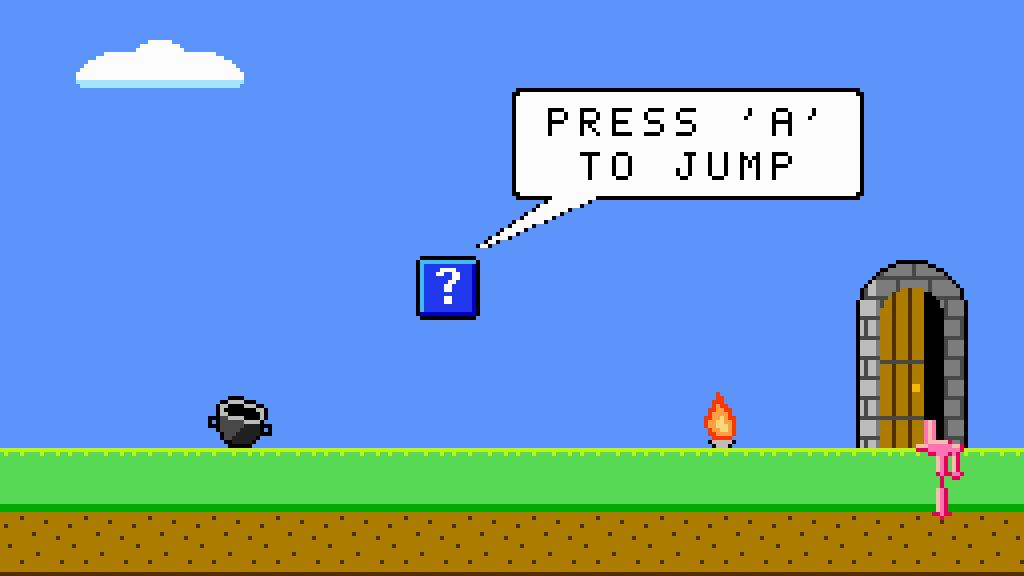
After all, you have a game, and you want to do the most you can to ensure your players or users know how to navigate your world. So you do what any creator would naturally do, like a mother with her child: you hold their hands.
Know Your Audience
I often write about “Know Thyself” in my posts on AI. “Know thy audience” is similar. Do they need their hands held, or are they mature players? I’d argue against hand-holding even if you were building games for small children. We tend to hold hands easily via written text, and that is probably not the best way to teach a small child to play.
Think about games for the very young: if words are not an available medium, then you need to do something else. You teach by showing. That is creativity rearing its head due to constraint. Since words were not available, you had to be creative, and think about other ways to teach.
The psychologist Jerome Bruner had names for this. In 1966, he described three ways we hold on to what we know: through action, through images, and through symbols like words and numbers. Children grow into them in roughly that order, but he didn’t think the order ever really goes away. Meet something new, even as an adult, and the best path in is the same one: do it, see it, and only then name it.
And when your audience levels up, by being older and able to read your written words, they graduate into being able to read complex plots, stories, and narratives. But they never needed you to continue holding their hands and teach them to play by reading yet more text. They still, like their younger counterparts, just needed to be shown how to play. When words became an unconstrained medium, we were all too eager to use them for teaching. But nobody learns how to solve complex algebra by simply being told how to do so. They are shown, on a chalkboard, or a whiteboard. Visualize the X being isolated on one side, they explain. And then they show what that looks like on the board.
There’s research behind the chalkboard, too. In 1985, John Sweller and Graham Cooper found that algebra students who studied worked examples - problems already solved, step by step - went on to solve similar problems faster, and with fewer mistakes, than students left to grind through the problems on their own. Showing beat telling, and it even beat figuring it all out from scratch.
Sequelitis
The message block and the innkeeper are both teaching a player by telling the player. Super Mario World and Final Fantasy were by no means bad games - in fact, they were both excellent games. But telling is less effective than teaching a player by showing. Mind you, both of these games did a good job at teaching by showing too.
One game stands out for teaching a player by showing - and that is Mega Man X. This I discovered from a YouTuber called Egoraptor, who wrote and produced a video series called Sequelitis. I mentioned it last time and promised it a post of its own, because it’s something that stuck with me for a long time, ever since the day I first watched it. Egoraptor uses the word designers use for this craft: conveyance. Good conveyance gets across what to do without a word. Bad conveyance is the moment you put the controller down and ask, “What do I do? Where do I go?”
That is something the game design industry has gotten wrong so many times, and the classic Nintendo games, which I love so very much, got right so many times. The reason is simple: older games were more constrained, so they were forced to teach a player by doing. Newer games, and by extension, almost all of application development in general, get it wrong so often because they are unconstrained by resource, and therefore a lot less creative by consequence.
The Creativity Curve
That’s a big claim, so let me back it up a little, and then hedge it a little too.
Constraint isn’t a dial you can crank all the way up. In 2019, Oguz Acar, Murat Tarakci, and Daan van Knippenberg reviewed the research on creativity under constraints and found the studies disagreed - some said constraints helped, some said they hurt. Their way out of the mess was a curve, an inverted U. With too few constraints, we grow complacent and take the path of least resistance. With too many, there’s no room left to create anything at all. Somewhere in the middle, creativity peaks.
That’s the creativity curve, and I think it explains a lot - the table on your web app, and the tutorial pop-up in a modern game. When there’s always room for one more line of text, there will always be one more line of text.
Dr. Seuss wrote The Cat in the Hat from a list of words approved for early readers, and used 236 of them. His publisher, Bennett Cerf, then bet him $50 that he couldn’t write a book using only 50. The result was Green Eggs and Ham. Only 50 words, and still a national treasure of writing, one that generations of us can recite from memory. That’s the creativity curve, at maximum value.
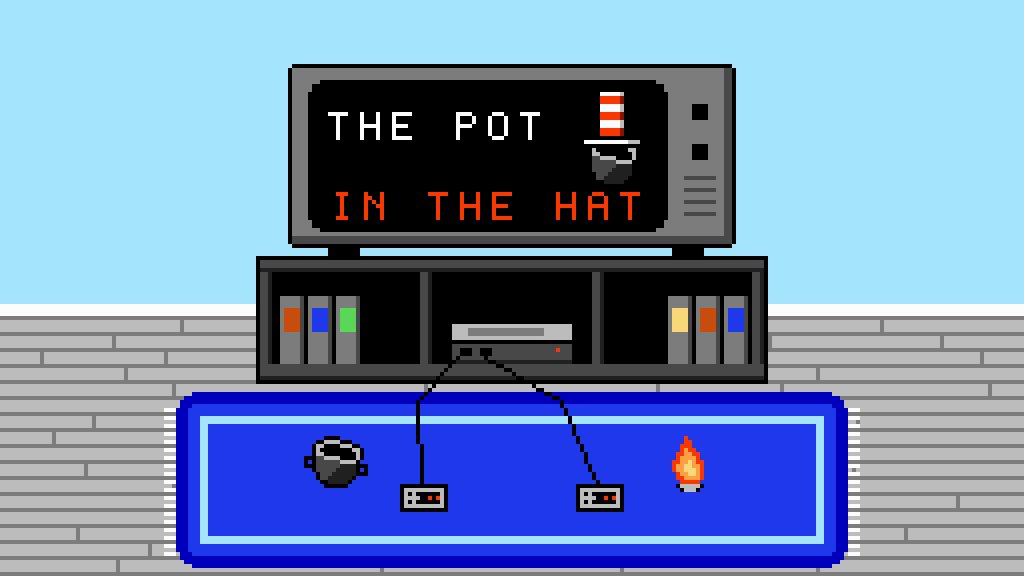
Constraint breeds creativity. You know, the Pot and the Flame are essentially 8-bit sprites. Or not totally, at least - but they are pixel art characters, and so is all the art on these articles. That leaves room for a little more creativity, not less. A handful of pixels, a short palette of NES colors, and no faces to lean on, so they have to say everything by posture: a pot tipped back to gaze up at a talking block, a flame already turned toward the door.
My other favorite example goes further still: Mark Dunn’s Ella Minnow Pea (2001). The island of Nollop honors Nevin Nollop, the supposed author of “The quick brown fox jumps over the lazy dog,” with a statue bearing his sentence in tiles. One day the Z falls off. The island council decides it’s a sign from Nollop beyond the grave, and bans the letter Z from speech and writing. Then the Q falls. Then the J, then the D, and on down the line. The whole book is told in letters between the islanders, and here’s the trick: Dunn’s letters obey the ban too. Every time a tile drops, it disappears from the page.
And the tale still gets told. When the D goes, the council hands out new names for the days of the week, and Ella worries about how anyone will write the past tense. Her aunt, a schoolteacher, quits, because she can’t teach without the word and. You never need a narrator to tell you the island is suffocating. You watch the alphabet shrink, and you feel it.
By the end, only five letters are left: L, M, N, O, P. Sound them out. The title of the book was sitting there the whole time, a lede buried so far and deep that it only surfaces on the last pages. It reminds me why a build-up to a crescendo can be so effective in a game. We play with objectives, and when they’re hard, we get such a splash of euphoria upon completion. That euphoric feeling is real at the end of Ella Minnow Pea. LMNOP.
I can’t resist bringing it to AI, either. Want cheaper token costs? Try caveman speak - “why use many token when few token do trick,” as one popular project puts it. Want something a little more fun? Give it the Ella Minnow Pea treatment: ask for a story, and take away a letter every paragraph. It won’t save you a cent - an AI reads in chunks of words, not single letters, so it’ll likely spend more, reaching for longer and stranger words. But watch what it comes up with. Caveman speak sits on the cheap side of the curve. The lipogram sits right at the peak.
Now the hedge. To be fair to the newer games, the old ones had a secret weapon: the instruction manual. A lot of the telling didn’t disappear on the NES; it just moved out of the cartridge and into the box. And plenty of NES games failed to teach at all. Castlevania II: Simon’s Quest still has players kneeling at a cliff with a red crystal, waiting for a tornado the game barely hints at. Constraint doesn’t guarantee creativity. It raises the stakes, and some designers met them while others didn’t.
And some modern designers put the constraint back on purpose. Jonathan Blow built The Witness without a single word of instruction. “We can do some very interesting things if we put down language as a crutch for communication,” he told The Guardian. “That’s the experiment of this game: just don’t use language at all.”
Tools of the Show
You can show a player in a number of ways. One way that has always stood out to me was the eager invitation. A doorway is something that usually invites us to explore, because of its simple, inviting, almost come-hither shape. A door by itself, as a simple black shadow, is less curious. A door with a sneak peek of something, perhaps something almost oozing out, is much more curious. And so the artifact of the curious is usually something out of place. A wall with a crack. An enemy with a chatbox. When something is different, it piques our curiosity, and this usually can show the player something important: pay attention to enough detail, and you’ll learn everything you need to know.
Walt Disney built whole parks on that come-hither shape. He called his version the “weenie” - a landmark like Sleeping Beauty Castle, placed at the end of a path to pull you down it. “People won’t go down a long corridor unless there’s something promising at the end,” he said. “You have to have something that beckons to them.” In Journey, the mountain sits on the horizon from nearly the first moment, and you never need to be told where you’re going.
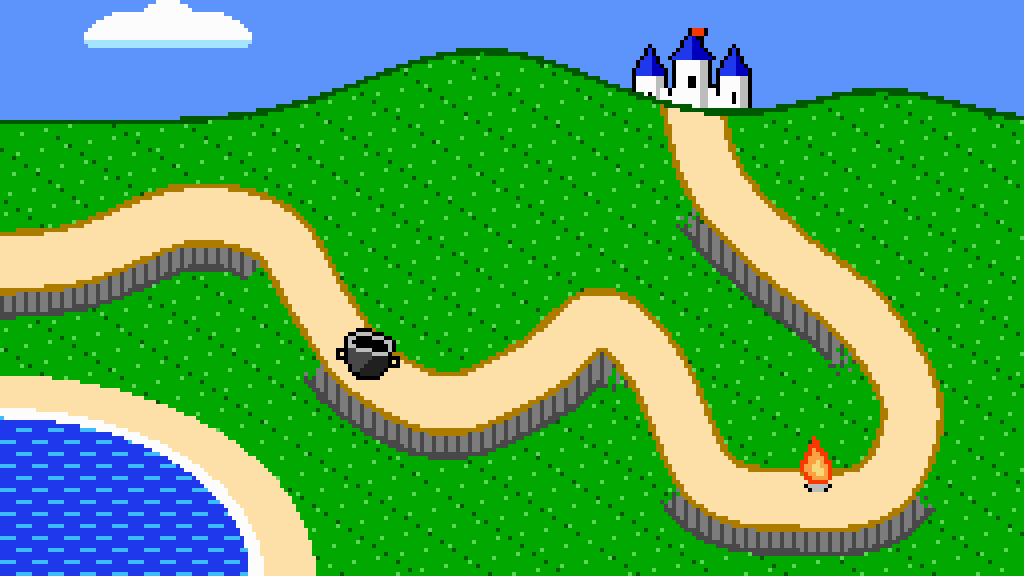
Then there’s the “safe pit,” a place to fail before failure costs anything. Shigeru Miyamoto has walked through how World 1-1 of Super Mario Bros. was built to help players “gradually and naturally understand what they’re doing.” The first enemy is a Goomba, a bad mushroom simple enough to jump over or stomp. Later, two staircases stand with solid ground between them, a safe place to miss the jump. Then the same two staircases come again, this time with a pit between them.
And then there’s the “demonstrator” - someone else does it first, and you learn just by being there. Remember the whole room listening in on Pavlovian Puppet? When Dave gets the Stacy talk in your second week, you’re getting it too, just by being in the same room, and you never need the talk yourself. Albert Bandura called it social learning. Games can put you in that room. Hold that thought, because Mega Man X does it better than anyone.
Egoraptor shows how Mega Man X teaches you in its first few seconds. Some enemies you can jump over, some are too tall and need to be shot, and you have to avoid their shots while yours damage them. There are pits, a life bar, and extra lives that offer grace. When it came to the most complex topic, wall-climbing, the game had an answer for that too: a forced fall into a pit, with no way forward except to gravitate into that lesson. You walk to the wall because there’s nothing else to walk to, you jump, and you cling. And down at the bottom of that pit sit a couple of health pickups, in plain view - a little reward for trying out the trick you just taught yourself.
The title screen has a neat little touch, too, cool for its time. The cursor isn’t an arrow or a pointing finger. It’s X himself, and when you press the button to play, he fires his green charge shot. But it’s not your little lemon shots - the small yellow pellets your buster fires in the stage - and that’s odd. You don’t know how to make that blast yet.
Then comes the build-up to the end of the stage. Vile shows up in his ride armor, and nothing you do seems to touch him. He pins you. And Zero arrives, charging up a shot of his own that tears the arm right off Vile’s armor. Now you know what that title-screen blast was, and that it’s yours to earn: hold the button down. It’s a lede buried at the very start and paid off at the very end, and it tells you a lot by showing. Zero does speak a few lines afterward - you’re strong, but not as strong as him, not yet. The lesson had already landed, though. As Egoraptor put it, you didn’t watch a character feel helpless in a cutscene. You felt it, with your own thumbs, and now you want to be Zero.
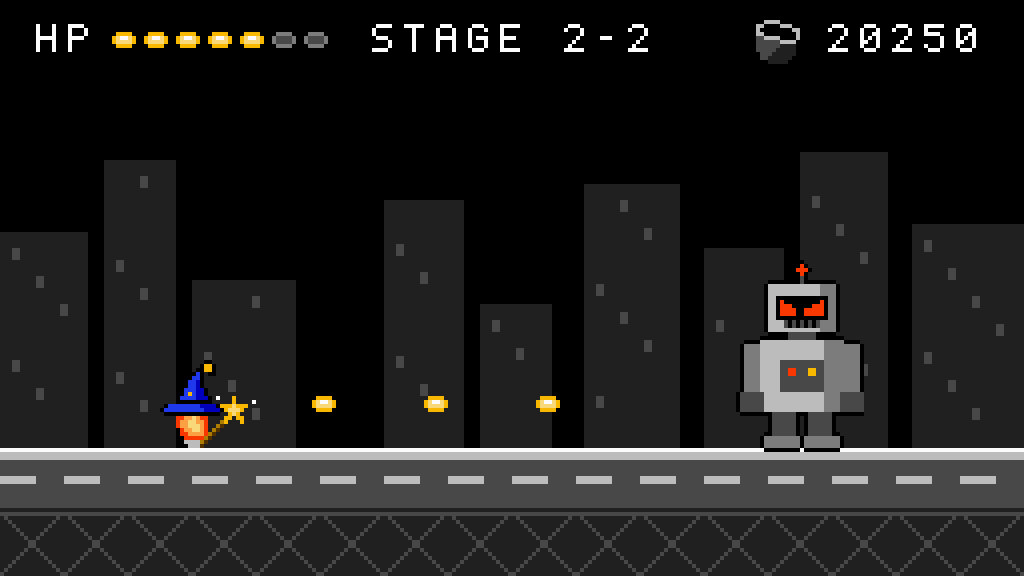
“I want to be him,” Egoraptor says, and so did every kid holding that controller. I want what he has. Imitation always was the best form of flattery, and it’s the basis for so much drive in the human world. Your neighbor buys a boat. Now you want one too. Mega Man X takes that old, ordinary want and hands you a whole game’s worth of goals to chase with it: every armor upgrade you find makes you look a little more like Zero.
The Fault of Intuition
Let me take a moment to breathe.
Anyone who’s listened to Egoraptor knows he uses this same trick of the pause. He loves Mega Man X, and he loves talking about it, and right after gushing over Zero, he catches himself: “Okay, so let me cool down for a second.”
Me, I love writing about this stuff - games, the philosophies behind them, how it all ties together with software engineering, and the AI of it too. And I feel like I’m shown a lot that’s never been written into words. So, a brief pause here, before we move on.
In my book on what makes a game fun, this lumps itself into the playability fault of Intuition. A game should be intuitive to play, because games offer temporary worlds we want to escape to, in places where the real world is less playable. When the real world makes a mistake on intuition - a door with a handle you’re meant to push, and a sign taped above it that says PUSH, or a furniture manual whose diagrams refuse to teach - we seek game worlds where those mistakes are not present (or at least, less present). But a lot of games have made similar mistakes. One of those mistakes is needing to explain with the written word how something works, when it could have been made more natural and intuitive.
Don Norman said it about doors and teapots back in 1988, in the book that became The Design of Everyday Things: “When simple things need pictures, labels, or instructions, the design has failed.” A PUSH sign is the real-world version of a message block. The door has already failed to show you, so it has to tell you.
There’s a deeper reason telling falls short. The philosopher Michael Polanyi opened The Tacit Dimension (1966) with a line I keep coming back to: “We can know more than we can tell.” His example was a face. You can pick a friend’s face out of a thousand, yet you could hardly tell anyone how you do it. Games are full of that kind of knowing. Your thumbs know exactly how far Mario jumps with a running start, and you couldn’t write it down if you tried. If knowing can’t be told, then it cannot be taught by telling, either. It has to be shown, and then done.
It has to be shown, and then done. I have to repeat that, because it’s explosive.
The ancient Chinese philosopher Xunzi got there more than two thousand years earlier: “Not having heard something is not as good as having heard it; having heard it is not as good as having seen it; having seen it is not as good as knowing it; knowing it is not as good as putting it into practice.”
One caution, though, before this turns into “throw them in the deep end.” Showing isn’t the same as leaving people alone. In 2006, Paul Kirschner, John Sweller, and Richard Clark looked back over half a century of studies and found that beginners left to discover things on their own learn less than beginners who get strong guidance. Mega Man X doesn’t leave you alone. It guides you every step of the way - the wall, the pit, the health in plain view, Zero’s shot. It just never says a word while it does it.
Some Things Need Not Be Spoken
I personally advocate for as few words in a game as possible. When I built Pysteroids, an Asteroids game in Python, I built it with the minimum. Even selecting a menu option was driving your ship into it - no typical up-and-down menu select. It’s always you, driving your ship. Mega Man X did a small version of the same thing, with X himself as the cursor on his own title screen. There’s a lot more to say about Pysteroids - how it was built, and why the Pot and Flame keep eyeing the cockpit - and I’ll save that for a future post in my Software Engineering series.
I don’t like having to explain something in the game. Perhaps in a game manual, an aside, or a strategy guide, yes - I’ve written a few strategy guides myself, and that’s exactly where I want my words to live. But in the game itself, I want a strongly magnetic world that feels real, keeps you glued inside, and doesn’t distract you. Egoraptor lampooned the alternative with a nagging tutorial voice - “Mega Man, Mega Man!” - piping up to warn you about a hole in the track, and that if you fall in it, you’ll die. The hole is obvious. Some things need not be spoken.
Ludwig Wittgenstein wrote, in his Tractatus, “What can be shown cannot be said.” He meant something about logic, not level design, so take it as a rhyme rather than a proof. But I like it for games, turned just slightly: what can be shown shouldn’t be said.
And what can’t be shown? Hold RESET while you turn the power off. That rule doesn’t live in the temporary world at all. It lives on the console, out where no level designer can reach it. So the innkeeper says it, every time, and he’s right to. Words are for what the world itself can’t show.
So the next time you build that table, try giving it half the screen. You might find yourself abbreviating the headers, and then wondering whether a few of those columns needed to be there at all.
In my book, What Makes a Game Fun, the fault of Intuition gets its full treatment, NES cart by NES cart. If you’d like to be the first to know when it’s published, sign up here.